
Just Earth News | @justearthnews | 10 May 2026, 01:57 pm Print
 Hantavirus
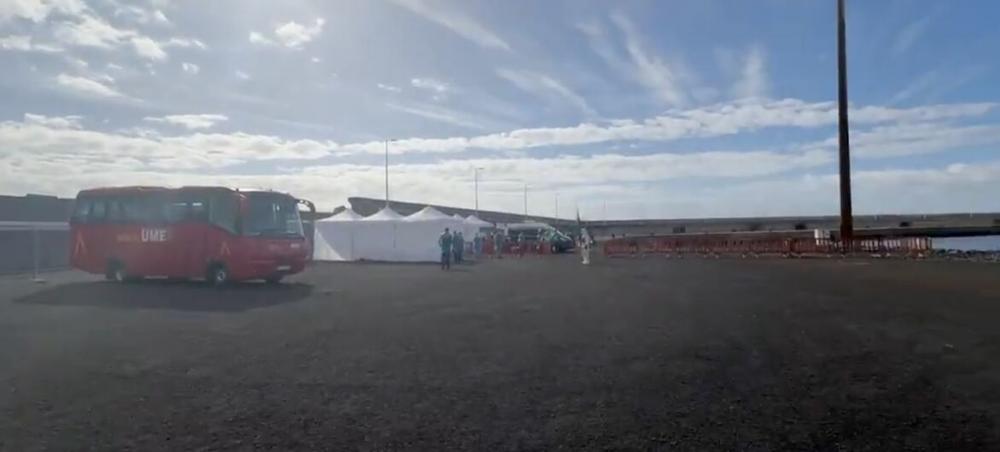
 Passengers from MV Hondius assisted by Spanish and WHO health teams after disembarking. Photo: WHO
Passengers and crew from the cruise ship MV Hondius began disembarking in Tenerife on Sunday under a tightly coordinated international health operation led by Spanish authorities and the World Health Organization (WHO), as officials sought to reassure the public that the outbreak “is not another COVID.”
The vessel arrived off the Canary Islands after weeks at sea at the centre of an international public health response triggered by a hantavirus outbreak that has claimed three lives.
WHO Director-General Tedros Adhanom Ghebreyesus, who is leading a team in Tenerife, stressed that the risk to the wider public remains low.
“This is not another COVID,” he told journalists during a media stakeout on Sunday, adding that “the risk to the public is low” and that people “shouldn’t be scared and they shouldn’t panic.”
There have been eight cases linked to the ship of which six cases have been laboratory-confirmed as hantavirus infections as of Friday, with all identified as Andes virus (ANDV), although no new deaths had been recorded since 2 May.
Disembarkation operation
The disembarkation operation began early in the morning, with Spanish health authorities boarding the ship to assess passengers and crew before transferring them ashore in stages based on nationality and flight availability.
According to WHO’s health operations lead in Tenerife, Diana Rojas Alvarez, passengers and crew from Spain, France, Canada and the Netherlands were among the first groups to leave the vessel.
“It has been extremely intense, but also very well organized,” she said during a WHO media briefing.
Around 46 passengers and crew were expected to disembark on Sunday, with operations due to continue into Monday. About 30 crew members are expected to remain on board as the vessel returns to the Netherlands accompanied by a medical team.
Repatriation flights
WHO officials said none of the passengers would travel on commercial flights. Instead, chartered repatriation flights are being coordinated with national authorities under strict health protocols.
Maria van Kerkhove, WHO Director for Epidemic and Pandemic Management, said passengers and crew would undergo active health monitoring for up to six weeks because of the virus’s incubation period.
“Our recommendation is for active follow-up, which means daily monitoring, checking for fever or other symptoms,” she said, adding that WHO recommends either home or facility-based quarantine and monitoring for 42 days.
“This is really a cautionary approach to make sure that we don’t have any opportunities for this virus to pass from others. We’ve also recommending when they get off the boat and when they are around others to be wearing a respirator, for that extra layer of protection.”
The hantavirus disease
Hantavirus is a rare disease usually linked to exposure to infected rodents and can cause severe respiratory illness. The Andes strain associated with the outbreak is the only known hantavirus strain with documented human-to-human transmission, although WHO has said that transmission risk remains low.
The agency said the operation in Tenerife involved close coordination between Spain, the Netherlands, the European Centre for Disease Prevention and Control (ECDC) and WHO teams on the ground.
“This is what WHO does,” Dr. van Kerkhove said, noting that the agency routinely coordinates international responses to infectious disease threats even when public attention is limited.
- Small diet changes, big heart benefits: 20-year study delivers good news for you
- Want to stay younger? Visiting the cinema or a museum may be the secret
- Think your lungs heal after quitting? New study challenges a common belief
- Your Apple Health data can now talk to ChatGPT—OpenAI launches new health feature
- Are you a night owl? Study warns of higher risk of obesity and metabolic problems
-1784726564.jpg "Image of the day: July 22, 2026")