
Just Earth News | @justearthnews | 26 Oct 2026, 01:55 am Print
 Brazil
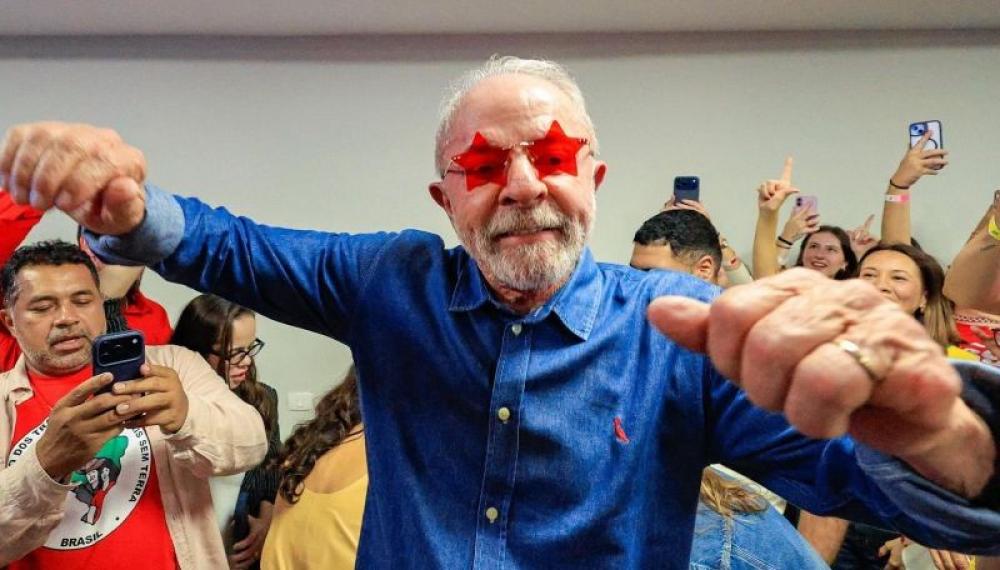
Lula celebrating his victory in Brazil Presidential elections. Photo: Lula Facebook
Leftist leader Luiz Inácio Lula da Silva has scripted history by winning a fourth, non-consecutive term as Brazil's President, defeating far-right candidate Flávio Bolsonaro, media reports said.
At 80, Lula defeated Flávio, the eldest son of former Brazilian President Jair Bolsonaro, by more than three percentage points in the presidential runoff.
Lula secured 51.79% of the total votes, ahead of Flávio Bolsonaro, who received 48.21%.
Lula's victory is significant as he was trailing Bolsonaro in the opening round amid growing discontent with his Workers' Party over rising prices and past corruption allegations.
Reacting to his victory, Lula wrote on X, "My eternal gratitude to the Brazilian people, to the youth who took to the streets in defense of democracy, and to every person who made an immense effort to vote and defend the future of our country.
"You all move me and renew my hope. This victory belongs to a people who believe, who fight, and who never give up on building a more just, sovereign, and democratic Brazil. Thank you so much, Brazil! This victory is ours. The victory belongs to the Brazilian people!"
Minha gratidão eterna ao povo brasileiro, à juventude que tomou as ruas em defesa da democracia e a cada pessoa que fez um esforço imenso para votar e defender o futuro do nosso país. Vocês me emocionam e renovam minha esperança. Essa vitória é de um povo que acredita, que luta e que não desiste de construir um Brasil mais justo, soberano e democrático. Muito obrigado, Brasil! Essa vitória é nossa. A vitória é do povo brasileiro! ? @ricardostuckert
— Lula (@LulaOficial) October 26, 2026
Who is Luiz Inácio Lula da Silva?
Popularly known as Lula, Luiz Inácio Lula da Silva is a veteran Brazilian politician, former trade union leader and one of the most prominent left-wing leaders in Latin America.
Born on October 27, 1945, in Garanhuns, in Brazil's northeastern Pernambuco state, Lula grew up in poverty and worked as a metalworker before becoming a prominent trade union leader during the 1970s.
He helped establish Brazil's Workers' Party (PT) in 1980 and rose to national prominence through his advocacy for workers' rights and social welfare.
Lula first became President in 2003 and served two consecutive terms until 2010. His governments introduced social programmes aimed at reducing poverty and inequality.
However, his political career was later overshadowed by corruption investigations. He was imprisoned in 2018 following a corruption conviction but was released in 2019. Brazil's Supreme Federal Court annulled his convictions in 2021, restoring his political eligibility.
Lula made a political comeback in 2022, defeating incumbent President Jair Bolsonaro in a closely contested election to return to office in January 2023.
His latest victory marks another major milestone in a political career spanning more than four decades.
What does Lula's re-election mean for Brazil?
Lula's re-election signals continued support for his left-wing political agenda, which prioritises social welfare, poverty reduction and economic inclusion.
His government is expected to continue focusing on social assistance programmes, workers' rights and policies aimed at narrowing Brazil's economic inequalities.
However, the narrow margin of victory highlights the deep political divisions within the country.
With Flávio Bolsonaro securing 48.21% of the vote, the result demonstrates the continued strength of the right-wing political movement associated with his father, Jair Bolsonaro.
The new mandate also comes against the backdrop of concerns over rising living costs and questions about the government's handling of the economy.
Addressing inflationary pressures, sustaining economic growth and improving living standards are likely to remain key challenges for Lula.
On the international stage, Lula is expected to continue advocating for a greater role for developing countries in global decision-making, while maintaining Brazil's focus on climate change, environmental protection and the preservation of the Amazon rainforest.
His approach to relations with major powers, including the United States and China, will also remain significant for Brazil's economic and diplomatic priorities.
The election result therefore represents both a political victory for Lula and a test of whether his government can address economic concerns while navigating a deeply polarised electorate.
- ‘Brazil is no one's backyard’: Lula's blunt message to Trump after historic fourth-term win
- France protests: More than 1,300 arrested as clashes follow nationwide demonstrations
- Melania Trump claims key role in Russia-Ukraine ceasefire in Oleshky
- Meghan Markle ‘deeply distressed’ over reports of investigation into her father Thomas Markle Sr.
- Italy, Spain, Belgium, Portugal: Europe erupts in protests as energy costs soar, housing crisis deepens