
Just Earth News | @justearthnews | 25 Oct 2026, 08:05 am Print
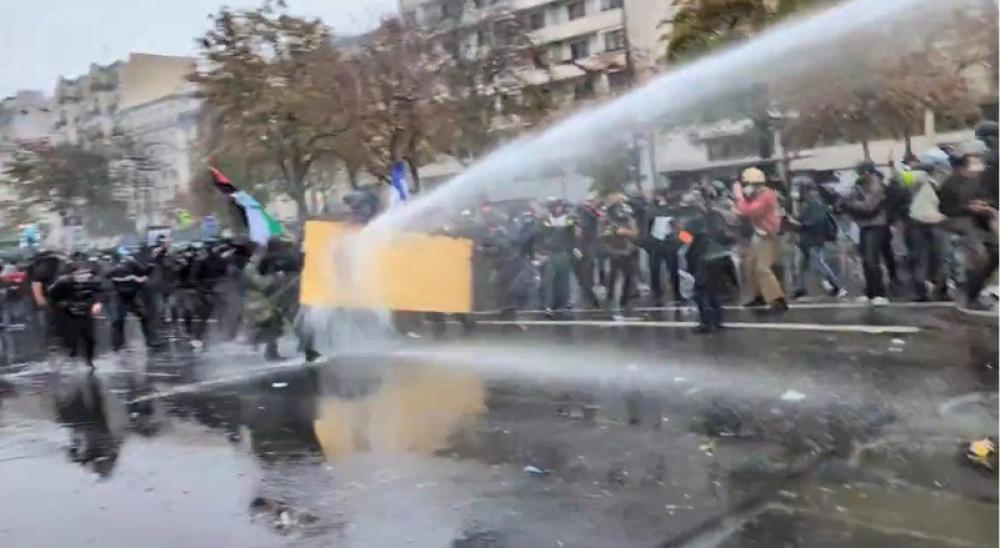
Photo: X screengrab
Paris: More than 1,300 people were arrested across France after a fresh wave of mass demonstrations against rising living costs, deteriorating public services and conditions in schools was followed by clashes between protesters and police in several cities, authorities said.
The French Interior Ministry reported 1,314 arrests during Saturday’s demonstrations, which drew an estimated 410,000 people nationwide, according to Reuters. Trade unions put the turnout at approximately 800,000, highlighting the gap between official estimates and organisers’ assessments of the scale of the protests.
Although most marches proceeded peacefully, confrontations erupted in Paris, Marseille, Bordeaux and other cities after demonstrations began to disperse. Police used tear gas and water cannon to contain groups of protesters, while some demonstrators threw projectiles and fireworks at security personnel.
The latest unrest came a week after France witnessed widespread rioting, looting and property damage during protests on October 17. Authorities deployed around 70,000 police officers and other security personnel on Saturday in an effort to prevent a repeat of the earlier violence.
???‼️ ALERTE INFO - La situation se tend à Paris. ▶️ La police fait usage d'un canon à eau contre les manifestants https://t.co/POXoQKhdIy
— Street live indépendant (@streetliveind) October 24, 2026
Reuters reported that the latest arrest total was roughly half that recorded during the previous weekend’s unrest, while the number of injured police officers also fell sharply. The Interior Ministry said around 50 officers were injured during Saturday’s disturbances, compared with more than 1,000 the previous weekend.
Paris, Marseille see confrontations after peaceful marches
In Paris, a large demonstration proceeded largely peacefully before clashes broke out around Porte de Vincennes, near the eastern end of the march route.
According to BBC and CNN reporting, police moved against groups of masked demonstrators, some of whom threw objects at officers and damaged property. Tear gas and water cannon were deployed as security forces attempted to disperse the crowds.
CNN reported that the Interior Ministry estimated around 110,000 people had demonstrated in Paris. Union organisers put the capital’s turnout considerably higher, at approximately 250,000.
Premières tensions au niveau du cours de Vincennes à Paris. Utilisation du canon à eau et gaz lacrymogène. #24octobre #24octobre2026 #Paris https://t.co/f4oOSivIb6
— Luc Auffret (@LucAuffret) October 24, 2026
In Marseille, France’s second-largest city, protesters set fire to makeshift barricades and rubbish bins, while police faced fireworks and other projectiles. Reports also emerged of damaged shopfronts and looting.
In Bordeaux, masked demonstrators were seen dismantling boards from buildings to construct barricades, while police used tear gas to disperse crowds. Authorities also reported disturbances in other cities, including Lyon, Toulouse and Rennes.
French Interior Minister Laurent Nuñez said the security operation had prevented a return to the scale of disorder witnessed a week earlier. He also accused radical activists of exploiting demonstrations to provoke violence.
The authorities’ response, however, has become part of the wider controversy surrounding the protests, with demonstrators and opposition politicians raising concerns about police tactics and restrictions on public gatherings.
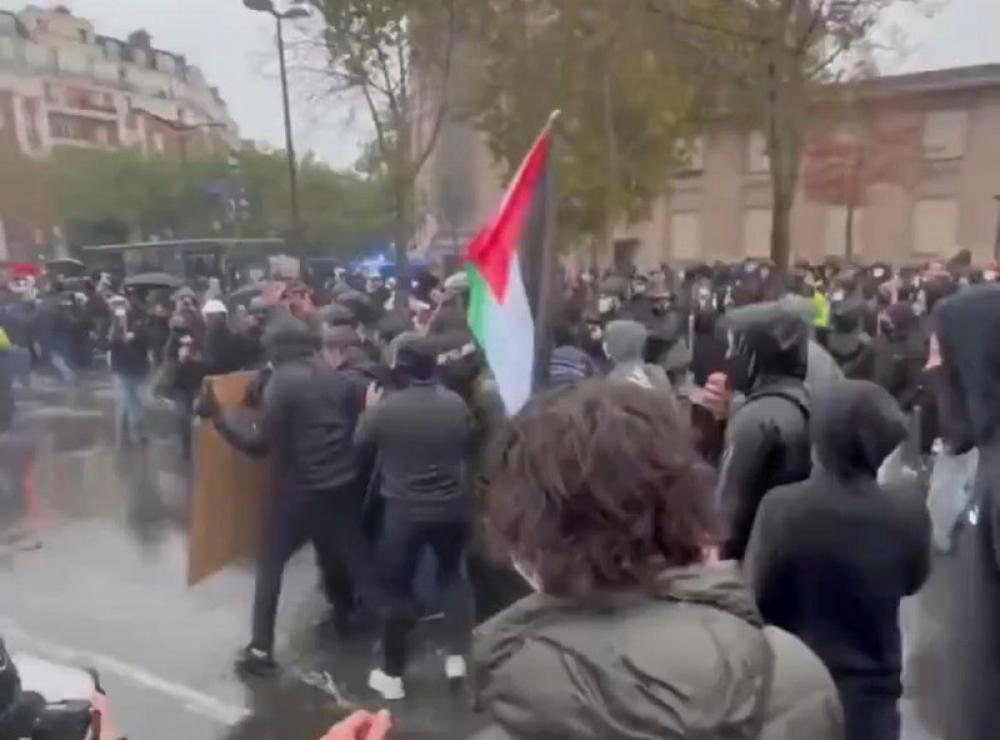 Photo: X/Screengrab
What are the protesters demanding?
The demonstrations began with student-led protests over conditions in secondary schools and universities but have expanded into a broader expression of discontent over the economy, public services and the government’s policies.
Students have called for greater investment in education, more teachers, improved school facilities and better financial support for young people. Workers and trade union members have joined them in demanding action on wages, inflation and the rising cost of living.
The protests have also attracted supporters of the Yellow Vests movement, which emerged in 2018 in opposition to fuel-tax increases and subsequently developed into a wider challenge to economic inequality and President Emmanuel Macron’s policies.
According to reporting by CNN and Fox the latest demonstrations reflect growing frustration among young people over employment prospects, education funding and the cost of housing and everyday necessities.
For some demonstrators, the grievances extend beyond individual economic measures to a broader perception that government policy has failed to address the pressures faced by lower-income households and younger generations.
The movement has also exposed tensions between peaceful protest organisers and groups prepared to engage in vandalism and confrontations with police. Authorities have argued that violent elements are using legitimate demonstrations as cover for disorder, while some protesters contend that economic hardship and anger over policing have contributed to the escalation.
Macron faces mounting pressure
The unrest presents another challenge for Macron’s government as France approaches a consequential presidential election period.
Macron is due to leave office in 2027, and the approaching election has intensified political competition between the country’s major ideological camps. The far-right National Rally, associated with Marine Le Pen, and the left-wing France Unbowed movement led by Jean-Luc Mélenchon are among the forces seeking to capitalise on public dissatisfaction. FollowPolitics
Political leaders have offered sharply different interpretations of the unrest. Right-wing figures have condemned the violence and criticised the government’s handling of public order, while left-wing leaders have supported the protesters’ economic demands and questioned the authorities’ response.
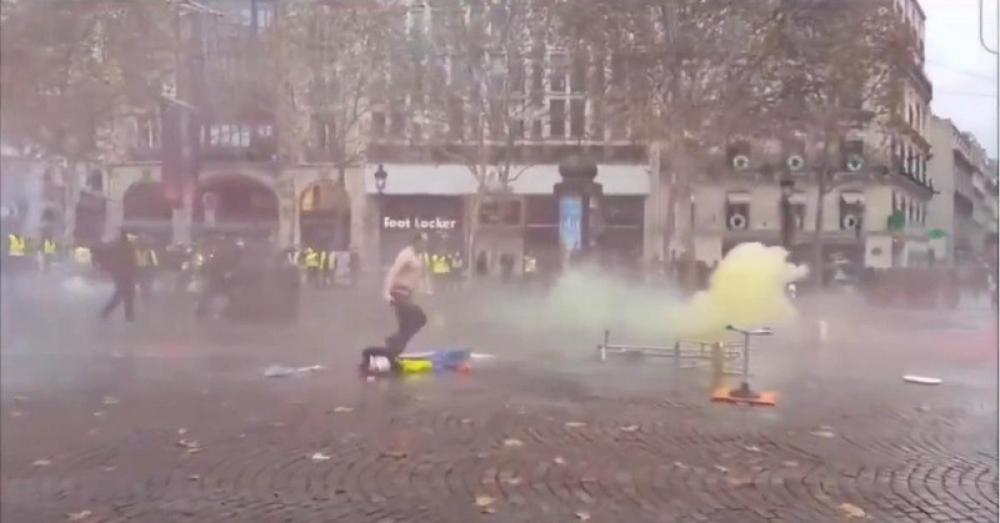 Photo: X/Screengrab
The government faces a difficult balancing act: maintaining public order while addressing demands for greater spending on education and social services at a time of pressure on public finances.
Previous negotiations with unions and student representatives have failed to resolve the central grievances behind the demonstrations.
More protests planned as unrest spreads beyond France
The latest demonstrations have not ended the protest movement. Trade unions and protest groups have called for further mobilisation, including demonstrations planned for October 31 and a nationwide strike on November 5.
The calls for further action suggest that the movement could evolve from a series of weekend demonstrations into a broader campaign involving workers across multiple sectors.
The unrest has also coincided with demonstrations and confrontations elsewhere in Europe. Reuters and other international organisations reported protests in Belgium and Albania, as well as heightened security measures in Italian cities following earlier disturbances.
France has a long tradition of mass demonstrations, from the student-led upheaval of May 1968 to the Yellow Vests movement. Such protests have historically served as a powerful means of challenging government decisions and pressing for political or economic concessions.
The latest wave, however, poses a fresh test of whether the authorities can contain violence without further alienating demonstrators whose grievances extend well beyond the immediate issues that first brought students onto the streets.
With more rallies and possible industrial action on the horizon, the government’s response in the coming days could prove crucial in determining whether the unrest subsides or develops into a more sustained national confrontation.
- Melania Trump claims key role in Russia-Ukraine ceasefire in Oleshky
- Meghan Markle ‘deeply distressed’ over reports of investigation into her father Thomas Markle Sr.
- Italy, Spain, Belgium, Portugal: Europe erupts in protests as energy costs soar, housing crisis deepens
- The Far Left Exposed? France Grapples With a Revolt Turning Violent
- Caught on live stream: Ecuador priest killed as crucifix falls on him during mass