
Just Earth News | @justearthnews | 15 Oct 2026, 07:15 am Print
 Hijab
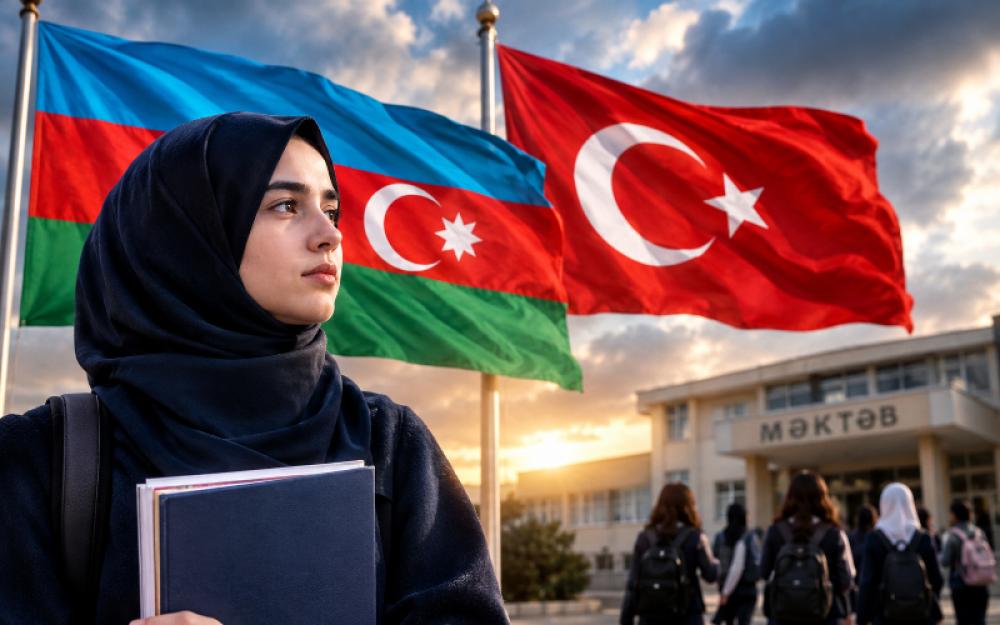
Hijab Azerbaijan is restricting hijabs in schools despite its 96% Muslim population. Representational AI image created by ChatGPT
A school dress-code dispute has opened an unusual rift between two close allies: Azerbaijan and Turkey.
The controversy centres on a question that has become politically sensitive across parts of the Muslim world — whether wearing an Islamic headscarf should be permitted in public schools that operate under a secular system.
Azerbaijan, where around 96 percent of the population identifies as Muslim, has introduced rules requiring pupils and teachers in state schools to comply with dress codes aligned with the country’s secular principles.
The regulations do not explicitly name the hijab, but reports that schools have turned away girls wearing headscarves have triggered protests and a debate over religious freedom and access to education.
The decision has also drawn criticism from Turkey, Azerbaijan’s closest regional ally.
Turkish officials and politicians have challenged the restrictions, while Azerbaijan’s ruling party has accused them of interfering in its domestic affairs.
The dispute has brought constitutional rights, national identity and the meaning of secularism into focus in both countries.
What has Azerbaijan changed?
The Azerbaijani government amended its school-uniform regulations on September 21, 2026, requiring clothing in state-run schools to comply with the prescribed dress code and the “principle of secularism”.
The rules were presented as an effort to set a consistent standard for public education rather than explicitly prohibiting any particular religious garment.
The state-run Azerbaijani Press Agency (APA) said the regulations aimed to ensure school clothing reflected the country’s secular character.
It also stated that clothing reflecting the “history, culture, and national and moral values of the Azerbaijani people” could be permitted during celebrations, subject to approval by the relevant Pedagogical Council.
The wording has become central to the controversy.
Although the regulations do not specifically mention the hijab, some schools have interpreted them as grounds to prevent headscarf-wearing pupils from attending classes.
Teachers have also reported being told that they cannot wear headscarves at school under the new requirements.
The rules have therefore raised questions about how a broadly worded requirement for secular dress should be applied.
For families and teachers affected by the restrictions, the issue concerns not only uniformity but also whether religious clothing can be treated as incompatible with public education.
Teacher Zahra Hasanova told Al Jazeera that she had been informed she could no longer wear the hijab at school.
“To be honest, I am a little emotional. I am hurt,” she said. “(The hijab) is a personal choice, and if one day I want to take it off, that should be my choice too.”
▶️ Video shows female students in #Azerbaijan ?? being turned away from school for wearing the #Hijab, as a ban on headscarves is enforced in public schools. https://t.co/5cjmCXjHrb
— Mahalaxmi Ramanathan (@MahalaxmiRaman) October 10, 2026
Why does secularism matter in Azerbaijan?
Azerbaijan’s approach to religious clothing is rooted in its history as a former Soviet republic and its constitutional framework.
The country lies in the South Caucasus, between eastern Europe and western Asia, and regained independence in 1991 after the collapse of the Soviet Union.
During the Soviet period, religious institutions and practices faced state restrictions.
After independence, Azerbaijan retained a secular system of government, in which the state does not formally govern according to the doctrines of a particular religion.
The country’s Constitution reflects that distinction.
Article 7 defines Azerbaijan as a secular republic, while Article 18 establishes the separation of religion and the state and provides for the secular character of state education.
Article 48, meanwhile, protects freedom of conscience, including the right to practise a religion or follow none.
These provisions sit at the heart of the current disagreement.
The government and its supporters argue that public schools must maintain a common dress code consistent with secular education.
Critics counter that preventing a pupil from entering a classroom because she wears a headscarf raises questions about the constitutional protection of religious freedom and the right to education.
Azerbaijan’s Muslim majority does not, by itself, determine how the state regulates religious expression in public institutions.
The dispute instead reflects competing interpretations of what secularism should mean in everyday school life — and where the state’s authority over uniforms should end.
Govt defends the restrictions
Azerbaijani officials have rejected allegations that the regulations amount to a general attack on religious freedom.
Their stated position is that the rules apply to the school environment and are intended to ensure consistency in students’ clothing.
Zahid Oruj, chairman of the human rights committee of Azerbaijan’s parliament, told Al Jazeera that the measure was not intended to undermine religious freedom or freedom of expression.
“There is no ban on wearing headscarves outside school, and the primary objective is to maintain uniform rules within the educational environment,” he said.
The government’s position distinguishes between the right to practise Islam in private and public life and the rules governing appearance in state schools.
Supporters of the policy argue that a common uniform can prevent visible differences in religious affiliation from shaping the school environment.
However, the practical consequences have extended beyond the wording of the regulations.
Reports of pupils being refused entry, alongside accounts from teachers who say they have been told to remove their headscarves, have intensified criticism of how the policy is being enforced.
Protests spread across schools
The restrictions have prompted demonstrations, online campaigns and reported class boycotts.
Videos circulated on social media showing distressed pupils embracing teachers as they were reportedly prevented from entering school while wearing headscarves.
Local media reported that students at at least two schools boycotted classes in protest.
On October 12, Azerbaijan’s Interior Ministry said 37 people had been detained in connection with incidents surrounding the enforcement of the dress-code rules.
Authorities said the detainees had disrupted public order.
The detentions added a law-enforcement dimension to a dispute that began with school uniforms.
The controversy has also reached prisons.
Journalist Polad Aslanov, who was convicted of high treason in 2020 and is serving a lengthy prison sentence, launched a hunger strike over the new requirements.
In a message posted on Facebook by his wife, Gulmira Aslanova, he said he was protesting what he described as a violation of constitutional rights.
Reports of disruption to internet services have also circulated.
While earlier accounts said claims of internet blackouts had not been verified by monitoring organisations, subsequent reports on October 13 described restrictions affecting social media platforms, including TikTok, Instagram and X.
The extent and precise circumstances of those restrictions have been reported differently, and they should be distinguished from the confirmed detentions announced by the Interior Ministry.
The protests have made the dress-code dispute a wider public issue, drawing attention to how the authorities respond to opposition and how students’ access to education is affected by the rules.
Why Turkey is opposing hijab restrictions
Turkey’s reaction is particularly significant because of its close relationship with Azerbaijan.
The two countries share linguistic and cultural links, maintain strong political and military cooperation, and frequently describe their relationship through the phrase “one nation, two states”.
Their close ties have not prevented disagreements over domestic policy.
In this case, criticism from Turkish political figures has focused on the exclusion of students who wear headscarves for religious reasons.
Oktay Saral, an adviser to Turkish President Recep Tayyip Erdogan, described the restrictions as “unacceptable” in a post on X.
He questioned how a student could be left at a school gate because she covered her head on religious grounds.
“The headscarf is not an obstacle; it is a requirement of faith,” Saral said, adding that the right to education should not be sacrificed to an ideological demand.
He called on Azerbaijan to reverse the decision.
Other figures from Turkey’s governing Justice and Development Party (AKP) also criticised the restrictions.
The issue has particular resonance in Turkey because headscarves were once restricted in universities and parts of public service under the country’s strict secular policies.
The Turkish criticism is therefore not only about Azerbaijan’s school rules.
It also reflects a political history in which the right to wear a headscarf became a major issue in debates over religious expression, state secularism and access to education and employment.
Turkey’s own history of headscarf bans
Turkey’s response is shaped by the experience of restrictions introduced in the aftermath of the military-backed intervention of February 28, 1997, often referred to as the “post-modern coup”.
In the years that followed, women wearing headscarves faced barriers at universities and in parts of the public sector.
Some were excluded from education or employment, while others faced pressure to remove their headscarves to continue their studies or careers.
The restrictions were gradually eased in later years.
Universities began lifting barriers to headscarf-wearing students around 2010, and restrictions affecting most female civil servants were removed in 2013.
The issue remains part of Turkey’s political memory, particularly for the AKP and religiously conservative constituencies that challenged the earlier restrictions.
The party’s political rise was closely associated with opposition to state-imposed limits on religious dress.
That history helps explain why reports of girls being turned away from schools in Azerbaijan have generated strong reactions among Turkish politicians and social media users.
For critics in Turkey, the scenes evoke a period when women’s religious clothing could determine whether they were able to study or work in public institutions.
Baku rejects Ankara’s criticism
Azerbaijan’s government has pushed back against criticism from Turkey, arguing that its education policy is a domestic matter.
The country’s ruling Yeni Azerbaijan Party (YAP) described Saral’s remarks as “populist and irresponsible” and warned that the dispute could harm relations between the allies.
In a statement reported by Turkish Minute, the party accused Turkey’s AKP of using the headscarf issue to fuel division and exert political pressure on Baku.
It argued that the principle of “one nation, two states” did not give either country the right to dictate the other’s domestic policies.
Azerbaijani President Ilham Aliyev also issued a warning against outside interference without directly naming Turkey.
Speaking at a congress of his party, Aliyev said others should not interfere with Azerbaijan’s way of life or tell the country how to conduct its affairs.
Ankara had not officially responded to that specific criticism in the reporting available at the time.
The exchange has exposed a sensitive distinction between close bilateral relations and the autonomy each government claims over domestic affairs.
Turkey’s critics of the restrictions have framed the matter around religious freedom and education, while Azerbaijan’s ruling party has portrayed outside criticism as political interference.
A dispute over faith, state identity
The controversy has placed Azerbaijan’s secular identity under renewed scrutiny.
The government maintains that its constitutional framework allows it to regulate school uniforms, while opponents argue that the enforcement of the rules is restricting the religious expression of Muslim pupils and teachers.
The dispute also highlights a difference between the two allies’ political experiences.
Turkey spent years dismantling restrictions on headscarves in universities and public institutions, whereas Azerbaijan’s current government is defending a secular dress code for state schools despite the country’s Muslim-majority population.
For now, the immediate questions concern how schools will interpret and enforce the rules, whether pupils wearing hijabs will continue to be denied entry, and whether the protests and diplomatic criticism will lead to any change in implementation.
The disagreement has moved beyond classroom dress codes into a broader debate over religious freedom, constitutional rights and the limits of state authority — while testing the relationship between two countries that regularly emphasise their shared identity and strategic partnership.
- US visa, green card applicants face stricter USCIS deadline rules from October 23
- Air France bans Pakistani pilots from Israel flights after security crackdown; United Airlines follows suit
- 'Won't go unchallenged': Muhammad Yunus heckling in New York triggers legal action warning
- OpenAI spy scare: Saudi man charged over 'Sophisticated' hidden recording device
- Pakistan test-fires Fatah-2 ER missile, claims capability to defeat enemy defences
-1791127926.jpg "Image of the day: October 4, 2026")