
Just Earth News | @justearthnews | 20 Oct 2026, 08:29 am Print
 Europe
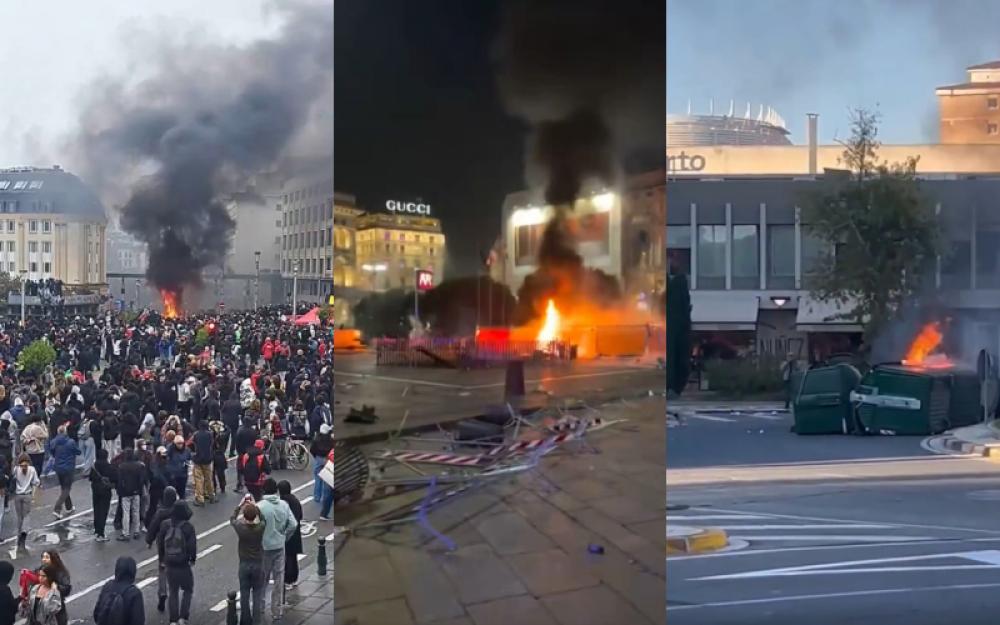
Italy, Spain, Belgium and Portugal face growing unrest. Photo: Screen grab from X
A growing wave of social unrest is sweeping across Europe, with demonstrations, strikes and clashes with police reported in Italy, Spain, Belgium and Portugal as households struggle with rising living costs, soaring energy prices and increasingly unaffordable housing.
The protests reflect mounting public frustration over economic pressures, government austerity measures, wages and public services.
While some demonstrations have turned violent, housing protests in Spain and Portugal have largely remained peaceful.
The developments come as several European countries prepare for politically significant elections, with rising living costs and public dissatisfaction adding to an increasingly tense political climate.
Le Monde reported that general strikes have been called in Italy for November 20 and in Spain and Portugal for November 11.
Italy sees clashes, mass mobilisation
Italy has witnessed some of the most serious confrontations, with clashes reported in Milan, Turin and Bologna, alongside road blockades in the south of the country.
Prime Minister Giorgia Meloni convened an emergency security meeting in Rome on Monday to assess the weekend's unrest and looting.
Earlier, she condemned what she described as “gangs of thugs” who were setting cities ablaze.
?Milan is a battlefield & tourists are hiding. Smoke bombs are being thrown at rooftop bars. Shops are locked down. A cost of living protest just became a riot in the heart of the city. Police are firing tear gas. Dozens have already been arrested. British tourists say they’ve never felt less safe and they’re rushing for the first flight home.
— Gauci Reports (@GauciReports) October 17, 2026
In Milan, masked demonstrators reportedly threw rubbish bins, iron bars and electric scooters at riot police near Piazza del Duomo.
Officers responded with tear gas, while several shops in the surrounding streets were vandalised.
According to public broadcaster RAI, the violence resembled “urban guerrilla warfare”.
Police arrested 271 people in Milan, including 220 minors, according to Le Monde.
Deputy Prime Minister Matteo Salvini subsequently announced on X that the government would deploy “500 additional troops to defend Milan”.
The city's chamber of commerce estimated the damage to businesses at €1 million, including property damage and lost revenue.
Its president, Marco Barbieri, said police had warned businesses about further demonstrations planned for October 24 and 25, advising them to prepare for possible early closures.
Unrest has also spread to schools. Since the beginning of October, students at several Italian high schools, particularly in Turin and Rome, have staged strikes over deteriorating school buildings and government policies.
Protesters have accused the Meloni administration of failing to control energy prices and prioritising support for Ukraine over investment in education.
BREAKING: Inspired by France, young second and third-generation migrants started looting stores in Milan, Italy around 2 hours ago. International mainstream media isn’t showing just how bad things are in Europe. https://t.co/ngDVLvDpj2
— Visegrád 24 (@visegrad24) October 18, 2026
A proposed education decree that would limit the number of foreign students in individual classes and prohibit full-face veils has also fuelled opposition among some young demonstrators.
In southern Italy, truck drivers, farmers and fishers have blocked major roads and motorway toll booths in Calabria and Campania, protesting particularly against fuel costs.
The country's largest labour union, CGIL, brought nearly 100,000 people onto the streets of Rome on Saturday, joined by opposition politicians including Elly Schlein and Giuseppe Conte.
Union leader Maurizio Landini called for a general strike on November 20.
Belgium reports arrests after violent protests
Belgium has also experienced demonstrations over government austerity measures, education and public services.
Protests took place in Brussels and Liège on Saturday, following earlier mobilisations in France.
The latest gatherings attracted fewer people than a demonstration on October 9, when tens of thousands marched in Brussels against federal government austerity policies.
However, the smaller turnout did not prevent violence.
? ?? BELGIQUE Chaos total à la gare Centrale. Affrontements et incendie. La tension monte. Les syndicats marchent vers la gare du Midi. Les étudiants, eux, restent sur place. À suivre. #Bruxelles #GareCentrale #Belgique #9octobre https://t.co/qabUohyptj
— Geocrises FR (@geocrises) October 9, 2026
Police in Brussels and Liège reported nearly 200 arrests, including more than 25 minors.
In Brussels, demonstrators erected barricades and threw projectiles near the Gare du Midi railway station.
Bicycles and electric scooters were set on fire, cars burned in the Marolles neighbourhood, and the windows of the Brussels federation headquarters of the Socialist Party were smashed.
Ahmed Laaouej, the party's leader in Brussels, sought to distinguish the perpetrators from the wider youth movement.
“The vandals are not the youth; they are brainless troublemakers. Don't lump them all together,” he said.
Belgian Interior Minister Bernard Quintin condemned the incidents as “sheer and simple violence”.
The unrest comes amid prolonged tensions over education.
Valérie Glatigny, the education minister for French-speaking students in Belgium, held the first meeting of an advisory committee on October 13.
The committee was established in response to months of teacher protests, although trade unions remain sceptical about the process.
Spain's housing crisis fuels protests
In Spain, access to affordable housing has emerged as a central issue in a largely peaceful protest movement ahead of early parliamentary elections scheduled for November 29.
Hundreds of tents have occupied Madrid's Puerta del Sol and squares in other cities for more than three weeks.
The encampments began on September 26, with demonstrators demanding measures to tackle rising rents and the difficulties many people face in securing housing.
???Breaking: Massisve riots are taking place in #Pamplona , #Spain right now. https://t.co/2TGQ1sELHk
— World_Breaking_News03 (@Breaking2003) October 15, 2026
The protests have created tensions with regional authorities.
Isabel Díaz Ayuso, the conservative president of the Community of Madrid, has sought to have the camps removed.
On Monday, she linked the demonstrations to unrest in France and Italy, saying: “They want nothing but violence and harassment, because the anti-democratic left of this country refuses to accept the verdict of the ballot box.”
The housing protests have coincided with industrial action by teachers.
Since October 14, educators in Madrid have staged rolling strikes demanding higher salaries and smaller class sizes.
Around 200 teachers blocked a motorway in the capital on Monday morning, according to Le Monde.
The country's main labour unions have called for a general strike on November 11.
If it goes ahead, it would be Spain's first general strike in 14 years, the report said.
Portugal sees mass rallies over wages, housing
Portugal has witnessed widespread demonstrations over wages, pensions and the rising cost of housing, with tens of thousands taking part in rallies in Lisbon, Porto and Coimbra.
The protests, organised by the country's main trade union confederation, CGTP, culminated in large demonstrations on Saturday.
Participants demanded higher salaries and pensions to offset the growing cost of living.
Housing affordability has become a major source of anger.
Property prices in Portugal have more than doubled since 2017, according to Le Monde.
#Portugal #Breaking Housing protest starts in #Lisbon with protesters setting tents at #Rossio Square. #acampada video via: https://t.co/uEOaRE3LVA https://t.co/cQ9br71Sgx
— José Miguel Sardo (@jmsardo) October 17, 2026
Demonstrators have also opposed a reform proposed by the centre-right government led by Prime Minister Luís Montenegro, which aims to accelerate tenant evictions in cases of unpaid rent.
Protest camps have appeared in Lisbon's Rossio Square and Praça Dom João I in Porto.
In Porto, demonstrators said they intended to maintain their encampment until the end of the year, despite police warnings and an initial eviction.
The gatherings have remained largely peaceful.
On Sunday, a popular assembly in Lisbon called for an “Iberian general strike” on November 11, coordinating its action with the planned mobilisation in Spain.
Rising costs put pressure on European governments
The demonstrations across southern and western Europe share several concerns, including higher energy bills, housing costs, wages and dissatisfaction with public services.
However, the immediate triggers and the intensity of unrest vary from country to country.
In Italy and Belgium, some protests have escalated into violent confrontations and arrests.
BREAKING: Milan, Italy right now, chaos caused by protesters. https://t.co/icNtvcWd8C
— Globe Eye News (@GlobeEyeNews) October 18, 2026
In Spain and Portugal, housing campaigns have relied largely on encampments and mass rallies, while unions are preparing further industrial action.
The unrest has also drawn the attention of European institutions.
On October 19, the European Commission condemned looting during protests in France as “unacceptable”, while stressing that the right to peaceful demonstration “must be protected”.
European Union leaders had discussed ways to reduce household energy bills at a meeting in Brussels on October 15, with the memory of France's 2018 Yellow Vest movement serving as a reminder of how cost-of-living grievances can develop into prolonged political unrest.
- The Far Left Exposed? France Grapples With a Revolt Turning Violent
- Caught on live stream: Ecuador priest killed as crucifix falls on him during mass
- Deadly fire at Bangladesh resort claims 10 lives
- Bali fuel crisis: Odd-even rule kicks in, travellers face disruptions
- US: Tesla operating in full self-driving mode rams into police cruiser, two officers hurt