
Just Earth News | @justearthnews | 24 Nov 2026, 03:23 am Print
 Indonesia
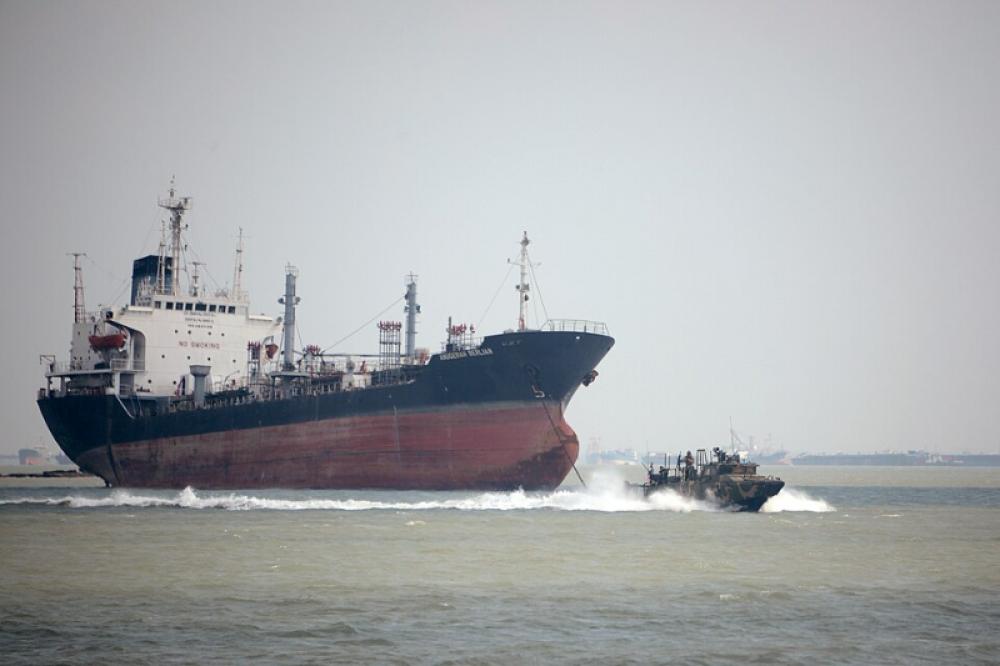
Representational image from Wikimedia Commons/Flickr/Naval Surface Warriors
The Indonesian Navy has intercepted a China-origin cargo vessel heading to Bangladesh after discovering 405 tonnes of sodium perchlorate, a chemical used in rocket and missile propellants, along with millions of unregistered blank 4G LTE SIM cards.
The vessel, identified as MV Star Line, was stopped in Indonesian waters off Belawan in North Sumatra on November 7 while travelling from Lianyungang Port in China to Mongla Port in Bangladesh, according to local Indonesian media reports.
Indonesian naval authorities made the seizure public on November 20 during a briefing at the headquarters of Naval Regional Command I in Belawan.
Vice Admiral Denih Hendrata, commander of the Indonesian Fleet Command, led the briefing.
The discovery has prompted an investigation into the shipment's ownership, intended recipients and the circumstances surrounding the vessel's unexpected stop in Indonesian waters.
Chemical found in 15 containers
During an inspection of the vessel's 36 containers, Indonesian naval personnel discovered 405 tonnes of sodium perchlorate stored in 15 containers.
They also found 54 pallets containing millions of blank, unregistered 4G LTE SIM cards.
Rear Admiral Deny Septian, commander of Naval Regional Command I, described sodium perchlorate as a strategic oxidising agent used in the production of rocket and missile propellants.
Indonesian naval officials said the seized quantity of the chemical could potentially be used to manufacture up to 100 missiles.
The discovery of such a large consignment, transported alongside millions of unregistered SIM cards, has led authorities to examine the purpose of the cargo and the parties involved in arranging its shipment.
Unscheduled stop triggered naval interception
According to Indonesian naval authorities, MV Star Line was expected to arrive at Mongla Port on November 8.
However, the vessel made an unscheduled stop in Indonesian waters, reportedly citing the need to refuel.
Its movements attracted the attention of a naval patrol.
The Indonesian Navy subsequently deployed KRI Sigalu-857 to intercept the vessel after detecting irregularities in its navigation patterns.
Authorities also reported that the ship failed to respond to radio communications.
Further checks allegedly revealed that its registration status had been suspended and some of its shipping documents might have been falsified.
These irregularities prompted naval personnel to conduct a detailed inspection of the vessel and its cargo, leading to the discovery of the chemical and SIM cards.
Importer, intended recipients remain unknown
Indonesian authorities have not publicly identified the importer of the 405-tonne sodium perchlorate consignment or the parties ultimately expected to receive the shipment in Bangladesh.
Investigators are examining the vessel's crew, shipping documents and cargo records to establish who arranged the transportation and who owned the goods.
Details of importers and transported consignments are generally recorded in a vessel's Import General Manifest (IGM).
However, as Indonesian authorities intercepted MV Star Line before it reached Bangladesh, investigators are working to establish the identities of the parties connected to the shipment.
The shipping company and organisations linked to the chemical consignment have also not been publicly identified.
What is sodium perchlorate?
Sodium perchlorate, represented by the chemical formula NaClO₄, is a powerful oxidising agent used in industrial processes and in certain rocket and missile propellant formulations.
The chemical is not itself an explosive or rocket fuel. Instead, it supports combustion by supplying oxygen, making it an important component in some propellant mixtures.
Beyond defence-related applications, sodium perchlorate is also used in laboratory processes and other areas of chemical manufacturing.
However, its oxidising properties require careful handling, storage and transportation.
Improper handling can create significant fire hazards, particularly when large quantities are involved.
- GTA 6 madness? Florida teen chases mother with electric chainsaw over Xbox
- Thailand hotel horror: American tourist dies after 'fight' with professional MMA fighter
- Iranian singer, four others receive 74 lashes over online performance without hijab
- Trump shares AI meme image of Jensen Huang recreating his assassination attempt moment. Here's the twist
- Texas phone store employee tried to send customer’s nude photos to himself, now in ICE custody