

Just Earth News | @justearthnews | 18 Mar 2026, 11:22 am Print
 Samsung
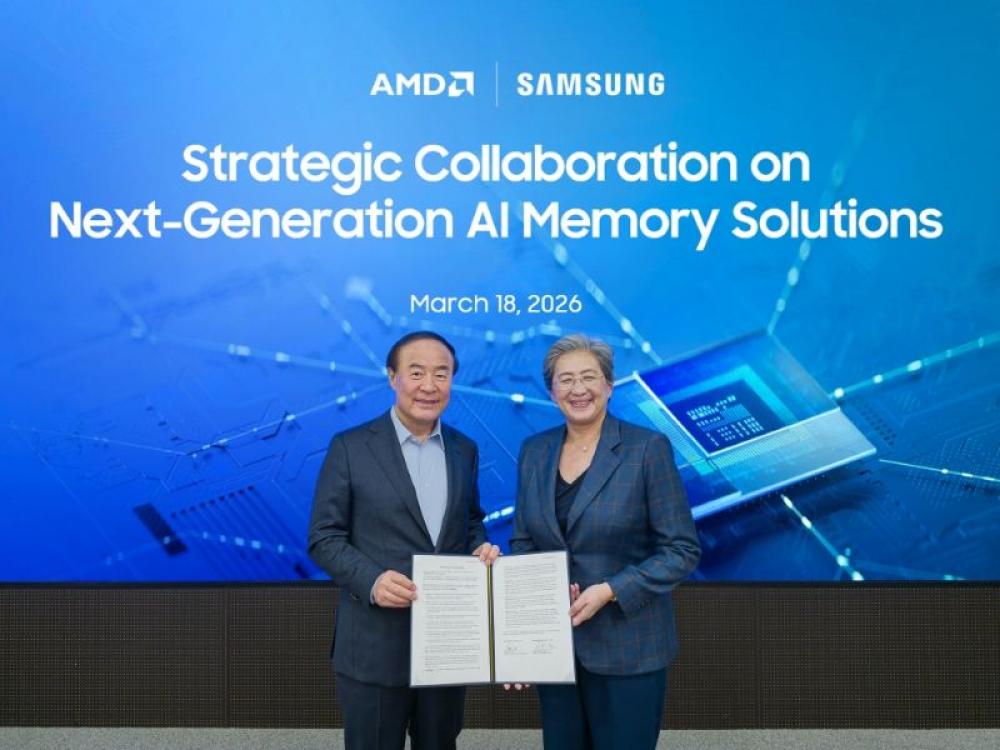
 Samsung Electronics Vice Chairman & CEO Young Hyun Jun (left) and AMD Chair and CEO Dr. Lisa Su pose with the memorandum of understanding (MOU). Photo: Samsung website
Electronic major Samsung Electronics on Wednesday announced it has signed a Memorandum of Understanding (MOU) with AMD to expand their strategic collaboration on next-generation AI memory and computing technologies.
The signing ceremony was held at Samsung’s most advanced chip manufacturing complex in Pyeongtaek, Korea, attended by Dr. Lisa Su, Chair and CEO of AMD, and Young Hyun Jun, Vice Chairman & CEO of Samsung Electronics.
“Samsung and AMD share a commitment to advancing AI computing, and this agreement reflects the growing scope of our collaboration,” said Young Hyun Jun, Vice Chairman & CEO of Samsung Electronics. “From industry-leading HBM4 and next-generation memory architectures to cutting-edge foundry and advanced packaging, Samsung is uniquely positioned to deliver unrivaled turnkey capabilities that support AMD’s evolving AI roadmap.”
“Powering the next generation of AI infrastructure requires deep collaboration across the industry,” said Dr. Lisa Su, Chair and CEO of AMD. “We are thrilled to expand our work with Samsung, bringing together their leadership in advanced memory with our Instinct GPUs, EPYC CPUs and rack-scale platforms. Integration across the full computing stack, from silicon to system to rack, is essential to accelerating AI innovation that translates into real-world impact at scale.”
Under the MOU, Samsung and AMD will align on primary HBM4 supply for the next-generation AMD AI accelerator, the AMD Instinct MI455X GPU, as well as advanced DRAM solutions for 6th Gen AMD EPYC CPUs, codenamed “Venice.” These technologies will support next-generation AI systems combining AMD Instinct GPUs, AMD EPYC CPUs and rack-scale architectures such as the AMD Helios platform.
Samsung and AMD are closely collaborating on advanced memory technologies for AI and data center workloads. As memory bandwidth and power efficiency become increasingly critical to system-level performance, this collaboration will help deliver more optimized AI infrastructure for customers.
An industry-first to enter mass production, Samsung’s HBM4 is built on its most advanced 6th-generation 10-nanometer (nm)-class DRAM process (1c) and a 4nm logic base die, featuring processing speeds of up to 13 gigabits-per-second (Gbps) and maximum 3.3 terabytes-per-second (TB/s) bandwidth that exceeds industry standards.
Powered by Samsung HBM4’s industry-leading performance, reliability and energy efficiency, the AMD Instinct MI455X GPU is expected to be the optimum solution for high-performance systems handling AI model training and inference.
The MI455X GPU will serve as a key building block for the AMD Helios rack-scale architecture, designed to deliver the performance and scalability required for next-generation AI infrastructure.
As part of their collaboration, Samsung and AMD will also work together on high-performance DDR5 memory optimized for the 6th Gen AMD EPYC CPUs. The companies aim to deliver industry-leading DDR5 memory solutions for systems built on the AMD Helios rack-scale architecture.
The two companies will also discuss opportunities for foundry partnership, through which Samsung would provide foundry services for next-generation AMD products.
Samsung and AMD have collaborated for nearly two decades across graphics, mobile and computing technologies, including Samsung serving as the primary HBM3E partner to AMD, powering the latest AMD Instinct MI350X and MI355X AI accelerators.
- Eliminated: Israel says Iran's Intelligence Minister Esmaeil Khatib killed in 'targeted strike'
- Middle East crisis: US hits Iranian missile sites close to Strait of Hormuz with bunker buster bombs
- Middle East tension: Israel says key power figure Ali Larijani killed
- War crime: Rashid Khan reacts to deadly Pakistani strikes on Kabul hospital
- Nvidia sees USD 1 trillion revenue opportunity from AI platforms by 2027, says CEO Jensen Huang



-1763561110.jpg "Image of the day: November 19, 2025")
