
Justearthnews 15 Sep 2016, 02:08 pm Print
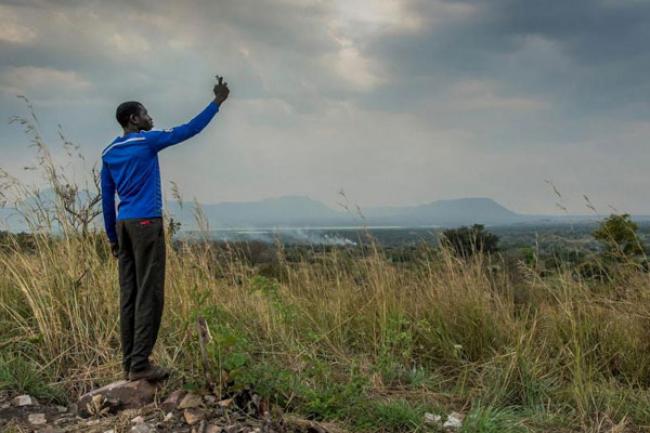
UNHCR/Frederic Noy
“In the world we live in on Wednesday, Internet connectivity and smart phones can become a lifeline for refugees, providing an essential means for them to give and receive vital information, communicate with separated family members, gain access to essential services, and reconnect to the local, national and global communities around them,” the UN High Commissioner for Refugees, Filippo Grandi, said in a news release.
“Most importantly, connectivity can help broaden the opportunities for refugees to improve their own lives and pursue a vision of a future that would otherwise be denied to them,” he added.
The report, Connected Refugees: How the Internet and Mobile Connectivity Can Improve Refugee Well-being and Transform Humanitarian Action, was published by the High Commissioner’s Office (UNHCR) and global professional services company Accenture.
The findings, based on research undertaken in 44 countries on four continents, come at a moment when wars and persecution have driven more people from their homes than at any time since UNHCR began keeping records. At end of 2015, 65.3 million people are displaced worldwide, of whom 21.3 million are refugees.
In the world we live in on Wednesday, Internet connectivity and smart phones can become a lifeline for refugees
According to the news release, the study finds that while affordability is often a barrier to connectivity, refugees living in urban areas tend to have similar access to mobile networks as other urban populations. But for refugees in rural locations the picture is very different, with only one in six located in areas with 3G (short for the third generation of wireless mobile technology) access, and one in five having no mobile coverage at all – significantly lower than for the population at large.
Faced with a pressing need, the study recommends additional investments in three main areas, which together form the basis of a new UNHCR Global Strategy for Connectivity for Refugees. These include increasing the availability of mobile networks, improving affordability, and providing access to training, digital content and services.
The report also identifies a number of strategic interventions to help ensure connectivity, ranging from partnering with mobile network operators and other technology and communications companies to improve infrastructure, making targeted investments in infrastructure, and enabling an environment and system for digital service delivery.
- Flydubai cockpit attack: Omani pilot tried to take control, UAE calls it 'terrorist act'
- Yom Kippur plot: 2 Iranians charged over plan to attack Manchester Jewish community
- UK-Iranian national arrested in RAF Fairford terror investigation
- Hijack scare on Flydubai flight travelling from UAE to Israel: Pilot 'tried' to seize control
- Pakistan attack: 3 traffic policemen killed as unidentified gunmen target mobile van
-1791127926.jpg "Image of the day: October 4, 2026")