
Just Earth News | @justearthnews | 03 Jan 2026, 05:58 am Print
 US-Cuba
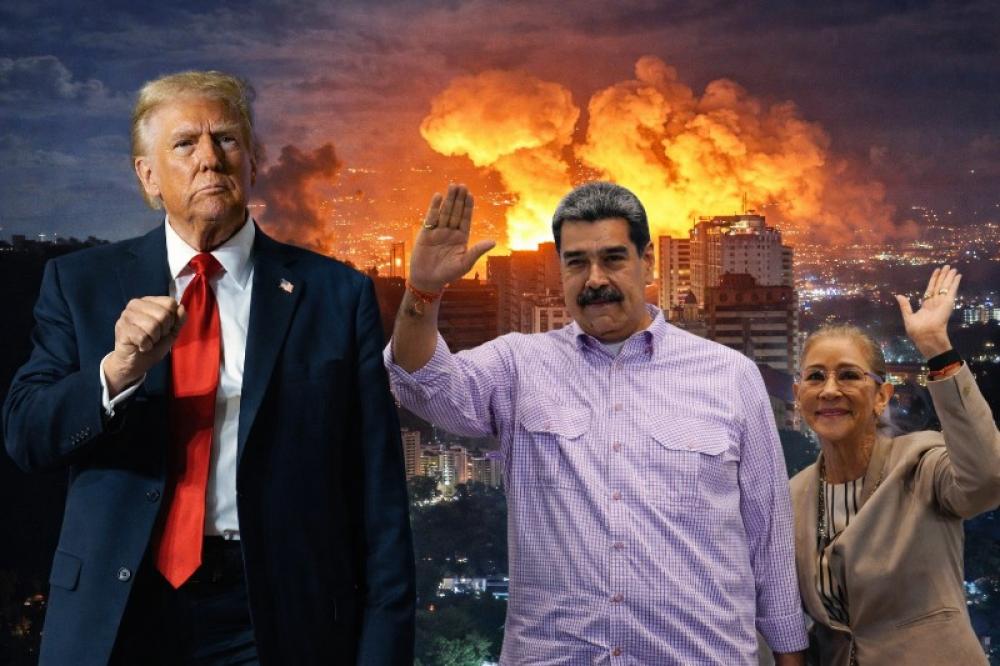
 US President Donald Trump claims Venezuelan President Maduro was captured after airstrikes. AI composition by ChatGPT
United States President Donald Trump on Saturday claimed that Venezuelan President Nicolás Maduro and his wife, Cilia Flores, were captured following large-scale US airstrikes across Venezuela, marking a dramatic escalation in Washington’s confrontation with Caracas.
In a post on his social media platform Truth Social, Trump said the United States had successfully carried out a coordinated overnight operation targeting Venezuela’s leadership, resulting in the capture of Maduro and his wife and their removal from the country.
He described the mission as a joint effort involving US military assets and federal law enforcement agencies.
“The United States of America has successfully carried out a large-scale strike against Venezuela and its leader, President Nicolás Maduro, who has been, along with his wife, captured and flown out of the country,” Trump wrote, promising further details at a press conference scheduled later at his Mar-a-Lago residence in Florida.
A top US official said elite special forces were involved in the operation.
Me EXCITA ver a Nicolás Maduro capturado.
— Gloria Alfa y Omega (@GlodeJo07) January 3, 2026
Que la vida le conceda MUCHÍSIMOS AÑOS DE VIDA y una salud inquebrantable para que pague tras las rejas todo lo que hizo.
Viva Venezuela LIBRE pic.twitter.com/YQMoRrjOI8
However, Washington has yet to issue an official government confirmation beyond Trump’s statement.
The strikes, which began in the early hours of Saturday, rocked Caracas and several other regions, including Miranda, Aragua and La Guaira.
Explosions, military aircraft, and plumes of black smoke were reported across the capital for nearly 90 minutes, according to witnesses and images circulating on social media.
Maduro’s government swiftly declared a national emergency and ordered the mobilisation of troops.
Venezuelan Defence Minister Vladimir Padrino appeared on state television, condemning the presence of foreign forces and calling on citizens to resist what he described as an attack on the country’s sovereignty.
“Free, independent and sovereign Venezuela rejects the presence of these foreign troops that have only left death, pain and destruction,” Padrino said, urging unity in the face of the assault.
En Caracas, instalaciones clave estatales están siendo bombardeadas por Estados Unidos.
— Isaac (@isaacrrr7) January 3, 2026
Se ha iniciado la operación para derrocar al tirano Nicolás Maduro y puede ser el principio del fin del narcochavismo.
¡Viva Venezuela libre!pic.twitter.com/8ZAJ926OZa
There was no immediate confirmation from Venezuelan authorities regarding Maduro’s alleged capture or departure from the country.
The Venezuelan opposition, led by Nobel Peace Prize laureate María Corina Machado, said it had no official comment on Trump’s claims.
Residents of Caracas described scenes of fear and confusion as blasts lit up the night sky.
Several neighbourhoods experienced power outages, particularly near major military installations such as Fuerte Tiuna and La Carlota air base.
Trump has repeatedly accused Maduro of turning Venezuela into a “narco-state,” alleging widespread drug trafficking and election rigging.
The US and several allied nations have rejected the legitimacy of Maduro’s continued rule, claiming he fraudulently retained power in the 2024 election.
Lo que se temía ya está sucediendo. Venezuela. pic.twitter.com/xVsruY2gkl
— Óscar Puente (@oscar_puente_) January 3, 2026
Maduro, who succeeded Hugo Chávez in 2013, has consistently denied the allegations, accusing Washington of orchestrating a campaign to seize control of Venezuela’s vast oil reserves — the largest proven reserves in the world.
The reported operation would mark the most direct US military intervention in Latin America since the 1989 invasion of Panama that led to the arrest of Manuel Noriega.
The move has revived painful memories across the region, where US interventions remain deeply controversial.
International reactions were swift.
Venezuela’s allies, including Cuba and Iran, condemned the strikes, with Tehran calling them a “blatant violation of national sovereignty” and urging the UN Security Council to intervene.
Legal experts have also raised serious questions about the authority under which the US strikes were conducted, particularly amid ongoing criticism of Washington’s recent attacks on suspected drug-trafficking vessels in the Caribbean and Pacific.
As uncertainty grips Venezuela and the region braces for fallout, Trump’s claim of Maduro’s capture has thrown Latin America into one of its most volatile geopolitical moments in decades.
- Trump says Iran wants truce, warns of 'stone age' blasts until Strait of Hormuz reopens
- India launches ‘Census of India 2027’. Where will it begin?
- Trump weighs exit from Iran war even as Strait of Hormuz remains closed: Report
- US expands visa screening: Social media accounts now under review from March 30
- Deadly Israeli strike kills 3 journalists—IDF makes stunning claim