
Just Earth News | @justearthnews | 05 Sep 2026, 09:34 am Print
 US-Iran
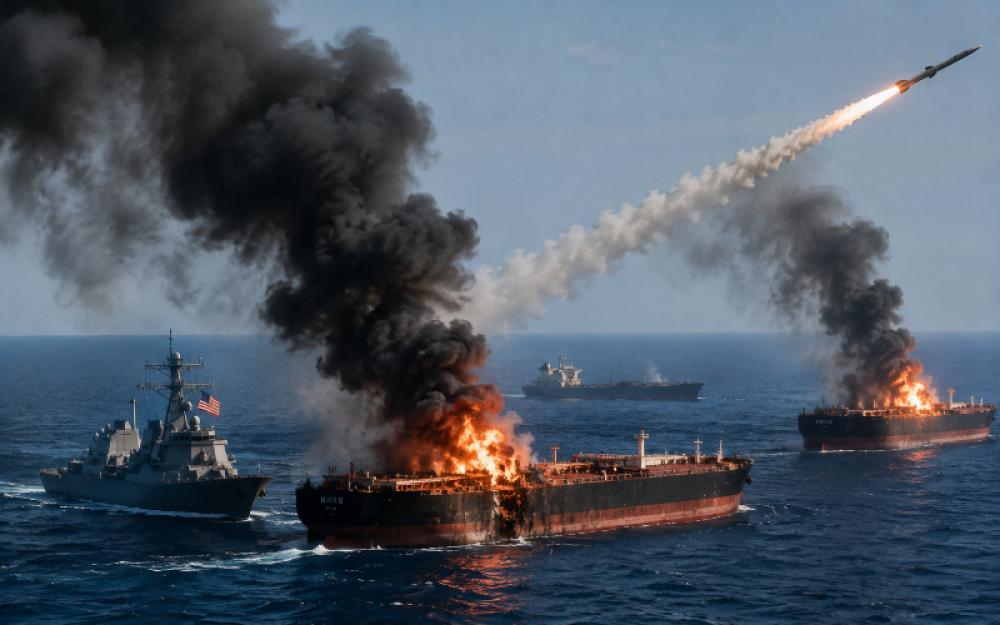
 Representational AI image created by ChatGPT
US forces destroyed or disabled three Iranian crude oil tankers on Saturday, hours after Iran launched ballistic missiles towards two US Navy ships, according to US Central Command (CENTCOM), marking another sharp escalation in the confrontation between Washington and Tehran.
CENTCOM said the American warships successfully evaded the incoming missiles and that no US personnel were injured in the attacks.
The latest military exchanges have widened the conflict’s maritime dimension, putting fresh focus on Iranian oil shipments and the strategically vital Strait of Hormuz.
CENTCOM warns Iran of higher economic cost
US Central Command commander Adm Brad Cooper said Washington’s response was intended to send a direct warning to Iran’s Islamic Revolutionary Guard Corps (IRGC).
“Let the message to the IRGC be clear: If you shoot at two of our ships, we will impose an even higher economic cost — taking out three of yours,” Cooper said, according to CENTCOM.
“We will not hesitate to defend American forces, and if necessary, destroy Iran’s limited and exposed oil fleet,” the command said in a post on X.
CENTCOM said US forces “permanently disabled” the crude oil carriers M/T Downy off Kharg Island and M/T Stark 1 near Jask.
It added that American forces had also destroyed the unladen crude oil carrier M/T Kylo, also known as the “Noxen”, in the Gulf of Oman. The vessel was struck at several critical points after its crew was ordered to abandon ship, according to the US military.
Strait of Hormuz becomes key flashpoint
The strikes have added to growing tensions around the Strait of Hormuz, one of the world’s most important energy corridors.
Around one-fifth of global oil supplies normally pass through the narrow waterway, making any disruption potentially significant for international energy markets and maritime trade.
Commercial shipping through the area has already declined sharply as military activity and attacks have increased risks for vessels and crews.
Washington has intensified military operations around the strait in recent days, accusing Iranian forces of threatening commercial shipping as well as US personnel operating in the region.
US expands strikes on Iranian military targets
American forces had earlier attacked Iranian military positions on Larak Island. Washington said the targets were connected to preparations to deploy sea mines and interfere with maritime traffic.
The US subsequently launched another series of strikes against Iranian military infrastructure along Iran’s southern coast.
According to CENTCOM, those attacks targeted air-defence systems, radar installations, maritime assets, mine-laying capabilities and communications facilities linked to the IRGC.
Iran responded with missile and drone attacks against US-linked positions across the region.
Tehran has also warned that it could further restrict oil shipments through the Strait of Hormuz if its own exports are prevented.
Iranian officials have repeatedly described the waterway as a potential pressure point in the confrontation with Washington.
Commercial shipping caught in escalating conflict
The latest tanker strikes followed reports of other attacks involving commercial vessels in and around the Strait of Hormuz.
Two supertankers were reportedly struck while leaving the waterway, heightening concerns among shipping companies and energy traders.
Another oil tanker was reportedly hit near Kharg Island, a major Iranian oil hub, although Iranian authorities had not immediately confirmed that incident.
The growing number of incidents involving commercial shipping has increased uncertainty for vessels operating through the Gulf and surrounding waters.
Oil markets react to growing supply concerns
The military escalation has already affected global energy markets, with Brent crude prices rising amid concerns that prolonged fighting could disrupt oil shipments from the Gulf.
Any sustained restrictions on traffic through the Strait of Hormuz could place additional pressure on global oil supplies while increasing freight, insurance and fuel costs.
The waterway’s importance means even a temporary disruption could have consequences well beyond the immediate conflict zone, particularly for countries and companies dependent on Gulf oil exports.
Washington and Tehran trade threats
The latest confrontation has also heightened fears that the conflict could expand further across the region.
US President Donald Trump has warned Iran of a stronger response if Tehran retaliates against American military action. Iran, meanwhile, has pledged to respond to what it describes as US aggression.
With the confrontation now involving military installations, oil assets and commercial shipping, the Strait of Hormuz remains a critical potential flashpoint.
Further attacks on vessels or any attempt to restrict navigation through the waterway could lead to additional military action and deepen uncertainty across global energy markets.
- Melania Trump claims key role in Russia-Ukraine ceasefire in Oleshky
- Meghan Markle ‘deeply distressed’ over reports of investigation into her father Thomas Markle Sr.
- Italy, Spain, Belgium, Portugal: Europe erupts in protests as energy costs soar, housing crisis deepens
- The Far Left Exposed? France Grapples With a Revolt Turning Violent
- Caught on live stream: Ecuador priest killed as crucifix falls on him during mass

-1791127926.jpg "Image of the day: October 4, 2026")