
Just Earth News | @justearthnews | 10 Apr 2026, 11:01 pm Print
 NASA
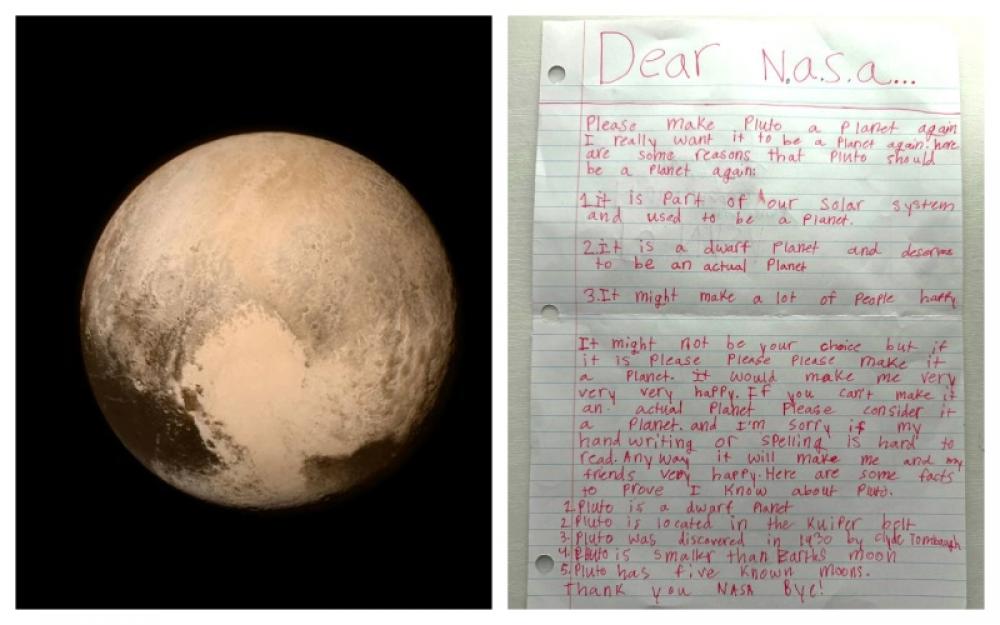
NASA Child writes letter to NASA demanding Pluto to be named as planet. Photo: Unsplash/@tropicalupdate
A heartfelt letter written by a 10-year-old girl to NASA, urging the restoration of Pluto’s status as a planet, has captured widespread attention online.
The letter has resonated with netizens for its emotional appeal as well as its grounding in basic scientific understanding.
“Please make Pluto a planet again”
In the handwritten note addressed directly to NASA, the child—identified as Kaela—made a simple yet earnest plea:
“Dear NASA… Please make Pluto a planet again. I really want it to be a planet again.”
Dear @NASA. From 10 year old Kaela. She is mailing to you today. Too cute not to post. She and her family are friends of ours. #bringplutoback pic.twitter.com/goPIb55iQG
— Mike's Weather Page (@tropicalupdate) April 9, 2026
She went on to justify her request by pointing out that Pluto is part of the solar system and was once officially recognised as a planet. In her innocent tone, Kaela added that it would make her “happy” if Pluto regained its planetary status.
NASA responds to viral letter
The letter gained further traction after a response from NASA leadership. NASA chief Jared Isaacman replied briefly, saying:
“Kaela — We are looking into this.”
Why Pluto is no longer a planet?
Discovered in 1930, Pluto was long considered the ninth planet in our solar system. However, in 2006, the International Astronomical Union reclassified it as a “dwarf planet” after the discovery of several similar objects in the Kuiper Belt.
Pluto is relatively small—about 1,400 miles (2,250 km) wide, roughly half the width of the United States—and orbits the Sun at an average distance of 3.6 billion miles. It has an extremely thin atmosphere composed mainly of nitrogen, methane, and carbon monoxide, with surface temperatures averaging around -232°C, making it inhospitable to life.
A unique world in the solar system
Pluto has five known moons, the largest being Charon, which is about half the size of Pluto itself. Because of their comparable sizes, Pluto and Charon are often referred to as a “double planet” system.
The only spacecraft to explore Pluto up close was New Horizons, which conducted a historic flyby in 2015, providing unprecedented images and data.
A Planet named by a child
Interestingly, Pluto itself owes its name to a young mind. In 1930, 11-year-old Venetia Burney from Oxford, England, suggested naming the newly discovered object after the Roman god of the underworld. The name was later adopted by astronomers.
- Unbelievable heat surge: UK breaks June record in relentless 37°C blaze. Why is it happening?
- Drought, extreme heat and heatwaves endanger millions of children globally: UNICEF
- Tech giant Amazon says its data centers are 7x more water efficient
- AI’s hidden impact: Study shows massive strain on water, land, and climate revealed
- El Niño 2026 warning: 90% chance of powerful climate event, WMO says