Top pick: Italy, Spain, Belgium, Portugal: Europe erupts in protests as energy costs soar, housing crisis deepens


Just Earth News | @justearthnews | 19 May 2026
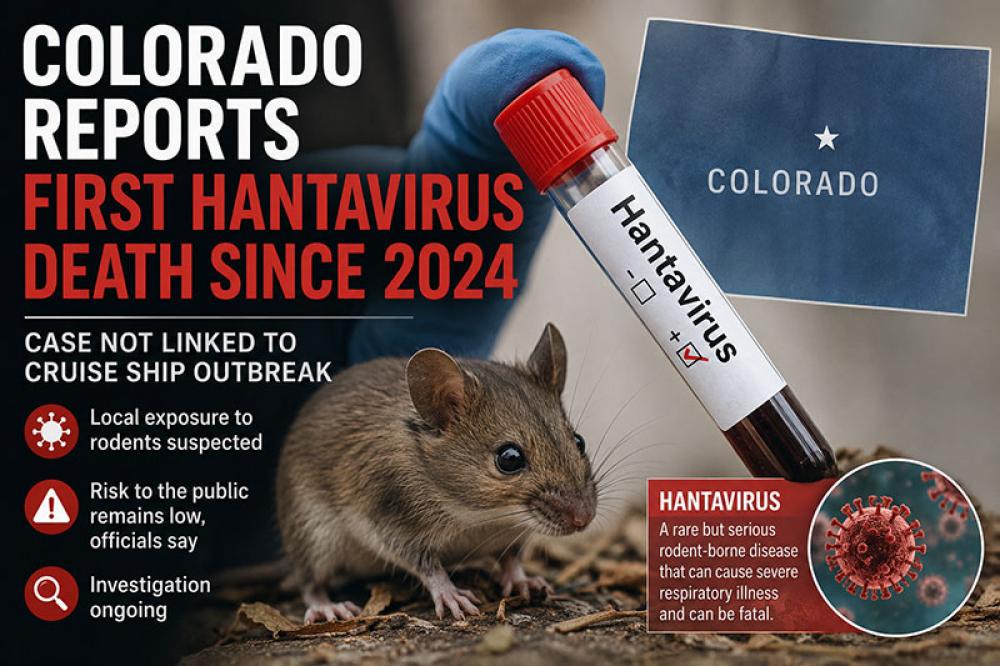
US reports first Hantavirus death of 2026 in Colorado. Photo: ChatGPT Recreated
The US state of Colorado has recorded its first death from Hantavirus since 2024, health officials confirmed, while clarifying that the case is not linked to the recent outbreak aboard the MV Hondius cruise ship that drew global attention.
In a statement, the Douglas County Health Department said: “The Colorado Department of Public Health and Environment and the Douglas County Health Department are investigating a confirmed case of hantavirus in a Douglas County adult that has resulted in death. This case is not linked to the MV Hondius cruise ship outbreak.”
Speaking on the case, Colorado Department of Public Health and Environment spokesperson Hope Shuler told The Colorado Sun that preliminary evidence indicates the infection was likely acquired through local exposure to rodents.
“The risk to the general public remains low, and the investigation is ongoing,” Shuler said.
Colorado’s history with hantavirus
According to the health department, infections caused by the Sin Nombre strain of hantavirus occur regularly in Colorado, particularly during the spring and summer months, and can lead to severe, sometimes fatal, respiratory illness.
In Colorado, the deer mouse is the rodent species most commonly associated with transmitting the virus to humans.
Health officials stressed that avoiding exposure to rodents and their urine, saliva, droppings, and nesting materials remains the most effective way to prevent infection.
The Colorado Department of Public Health and Environment said it is working closely with local partners under standard investigative protocols to determine the source of exposure.
Global concern after cruise ship outbreak
According to the United Nations Regional Information Centre, the recent hantavirus outbreak aboard the MV Hondius has renewed global attention on the virus, six years after the onset of the COVID-19 pandemic, raising concerns over the possible resurgence of serious infectious diseases.
Hantavirus is a rodent-borne disease that can trigger acute respiratory syndrome, though it is significantly less contagious than highly transmissible viruses such as COVID-19 or measles.
In 2025, eight countries in the WHO Region of the Americas reported 229 cases and 59 deaths, representing a case fatality rate of 25.7 percent.
Meanwhile, the WHO European Region reported 1,885 hantavirus infections in 2023 — equivalent to 0.4 infections per 100,000 people — the lowest rate recorded between 2019 and 2023.
The Andean strain of hantavirus remains a major concern because it is the only known strain with documented human-to-human transmission. It can cause severe pulmonary syndromes with a fatality rate of up to 50 percent. Cases detected aboard the MV Hondius involved this strain.
Symptoms and prevention
Initial symptoms of hantavirus infection often resemble influenza, including fever, headache, muscle pain, and gastrointestinal distress such as abdominal pain, nausea, and vomiting.
In severe cases of hantavirus pulmonary syndrome (HPS), symptoms can rapidly worsen, causing coughing, breathing difficulties, pulmonary edema, and shock.
Advanced stages of haemorrhagic fever with renal syndrome (HFRS) may lead to low blood pressure, clotting disorders, and kidney failure.
There is currently no vaccine or specific antiviral treatment for hantavirus, making prevention and early detection the most effective defenses against the disease.