Top pick: What this UK couple found inside an old paint can left them completely speechless


Just Earth News | @justearthnews | 20 Apr 2026
#David Gross nuclear warning #nuclear war threat 2026 #humanity survival risk #Nobel laureate warning nuclear war #global conflict escalation
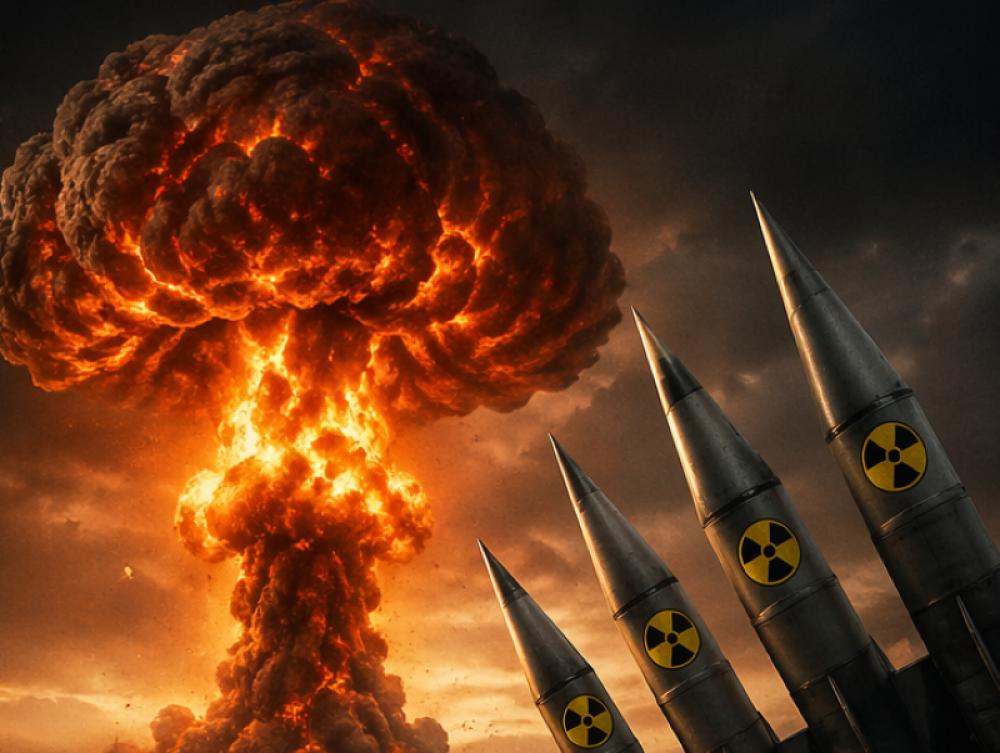
David Gross warns humanity may not survive another 50 years due to the growing threat of global nuclear war. Photo: ChatGPT recreated
Nobel laureate David Gross has warned that humanity may not survive another 50 years due to the growing threat of global nuclear war.
He cautioned that if current trends of conflict and geopolitical tensions continue, the world could face an existential catastrophe within the next 35 years.
“Currently, I spend part of my time trying to tell people that the chances of you living 50 more years are very small,” Gross told Live Science. “Due to the danger of nuclear war, you have about 35 years.”
Explaining his estimate, Gross said that even after the Cold War—when strategic arms control treaties were in place—there were calculations suggesting a 1% annual probability of nuclear war. “Things have gotten much worse in the last 30 years,” he said, adding that he now believes the risk may be closer to 2% per year.
“That’s roughly a 1-in-50 chance annually. At that rate, the expected timeframe before a catastrophic event is about 35 years,” he noted, while acknowledging that the estimate is not precise.
Gross also warned that the world is entering what he described as an “incredible arms race,” pointing to rising global tensions. “People are openly discussing the use of nuclear weapons. There is a major war in Europe, ongoing tensions involving Iran, and near-conflict situations like those between India and Pakistan,” he said.
Highlighting the growing complexity of global nuclear dynamics, he noted that there are now nine nuclear-armed states.
“Even three nuclear powers are far more complicated than two. The agreements and norms that once governed these relationships are breaking down,” he said.
He further cautioned about the increasing role of automation and artificial intelligence in military decision-making. “Weapons are becoming more advanced, and automation—possibly even AI—could soon be involved in controlling them. It will be very difficult to resist relying on AI because of how quickly it can act,” he said.
Gross shared the 2004 Nobel Prize in Physics with Frank Wilczek and Hugh David Politzer for their discovery of asymptotic freedom in the theory of the strong interaction.