Top pick: Europe in crisis: France heatwave triggers over 40 water-related deaths


Just Earth News | @justearthnews | 21 Mar 2026
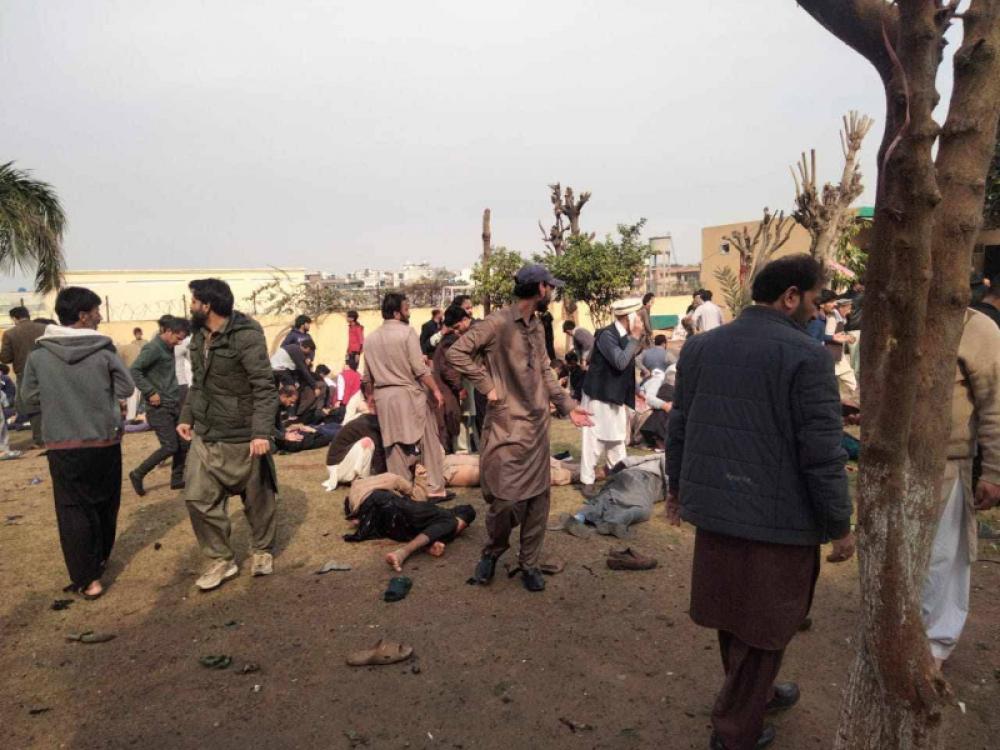
At least 40 people were killed in a suicide attack in a Shia mosque in Islamabad, Pakistan, February 6, 2026. Photo: Video-grab from X
Pakistan has emerged as the world’s most terrorism-affected nation, according to the latest Global Terrorism Index (GTI) 2026 report.
The country recorded 1,139 deaths, 1,045 attacks, 1,595 injuries and 655 hostages in 2025.
With a score of 8.574, Pakistan now ranks above all other countries on the index.
This marks its deadliest year since 2013 and the sixth consecutive year of rising terrorism-related fatalities.
Across South Asia, Pakistan stands out as the only country where the security situation worsened in 2025, while others registered improvement.
Violence concentrated in key provinces
The crisis remains heavily concentrated in two regions — Khyber Pakhtunkhwa and Balochistan.
Together, these provinces accounted for 74 percent of total attacks and 67 percent of deaths.
The figures highlight the persistent instability in Pakistan’s western and south-western borderlands.
TTP emerges as dominant threat
The Tehrik-e-Taliban Pakistan has emerged as the most lethal actor in the country.
In 2025 alone, the group carried out 595 attacks and was responsible for 637 deaths, accounting for 56 percent of all terrorism-related fatalities.
The report notes a sharp escalation in tactics, including a 450 percent rise in targeted assassinations and increasing attacks on police forces.
The group has also adopted new technologies, incorporating drones into its operations, signalling a shift in its capabilities.
Cross-border safe havens in Afghanistan
The report highlights the growing role of cross-border dynamics in sustaining the violence. Between 6,000 and 6,500 TTP militants are believed to be operating from within Afghanistan.
These fighters use Afghan territory as a base for launching attacks into Pakistan. Around 85 percent of TTP operations occur within 10 to 50 kilometres of the border, underlining the strategic importance of the region.
The return of the Afghan Taliban to power in 2021 has further complicated the situation.
Despite repeated requests from Islamabad, Kabul has not taken decisive action against TTP elements.
Legacy of militancy in border regions
The GTI analysis traces the roots of the crisis to Pakistan’s tribal belt along the Durand Line. For decades, these areas functioned as loosely governed zones where multiple militant organisations operated.
Groups such as the Taliban, the Haqqani Network and al-Qaeda found sanctuary in these regions, eventually paving the way for the rise of the TTP.
The report also points to ideological networks, including madrassas in refugee camps, which contributed to the formation and expansion of militant groups over time.
Balochistan attack signals escalation
A major escalation occurred in March 2025 when the Balochistan Liberation Army hijacked a passenger train and took 442 hostages.
This incident stands as the largest single terrorist attack recorded globally in the GTI’s 2025 dataset.
The report notes that the group’s campaign has evolved beyond separatism into broader anti-state violence.
Targets now include not only Pakistani security forces but also Chinese nationals and infrastructure linked to economic projects.
Strategic blowback and policy consequences
While the GTI does not directly address groups such as Lashkar-e-Taiba or Jaish-e-Mohammed, it identifies patterns that align with long-standing concerns about sanctuary-based militancy.
The report links Pakistan’s current crisis to structural conditions shaped by years of policy decisions.
These include the use of militant proxies, permissive border regions and a distinction between “good” and “bad” militant groups — a framework that has since collapsed.
The deterioration in India-Pakistan relations following incidents such as the Pahalgam attack and India’s response, known as Operation Sindoor, also features in the broader security context.
A crisis years in the making
Pakistan’s current GTI score reflects not a sudden breakdown but the cumulative outcome of long-term strategies.
In 2013, when the country last faced comparable levels of violence, military operations temporarily reduced attacks.
However, six consecutive years of rising fatalities suggest that those approaches have lost effectiveness.
The latest data signals a deepening internal security crisis, with implications not only for Pakistan but for the wider region.