Top pick: Melania Trump claims key role in Russia-Ukraine ceasefire in Oleshky


Just Earth News | @justearthnews | 28 Aug 2026
#Nepal floods #Nepal flood disaster #Nepal flood casualties #Nepal disaster #Nepal flash floods #Nepal flood deaths
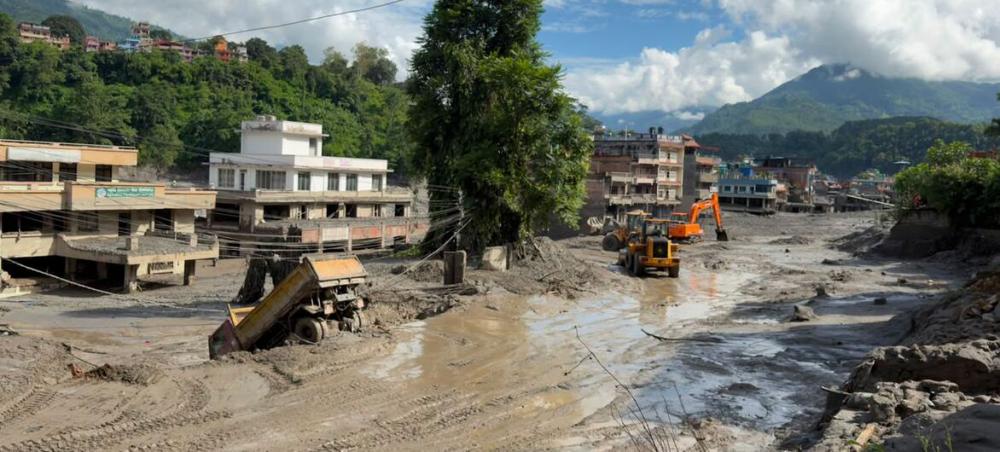
Buildings in Bagmati Province, Nepal, remain covered in mud after a devastating flash flood. Photo: UNICEF/Laxmi-Prasad-Ngakhusi
The impact of the deadly flood in Nepal has been described as “immense” as the authorities there confirm that 538 bodies have been recovered from the disaster-stricken area.
The catastrophic flooding occurred at the border between Nepal and the Tibet autonomous region of China.
It is thought to have been caused by the collapse of a glacier and the resulting landslide, leading to the destruction of entire communities as well as key infrastructure including bridges and roads.
On Friday, quoting Government of Nepal figures the UN’s aid coordination office OCHA said that 538 people had died, while almost 3,750 had been rescued. Around 1000 people are still missing, many of whom are thought to be tourists.
The Tibet autonomous region of China was also affected and some 560 people remain missing there, according to the authorities.
Lila Pieters Yahia, the UN Resident Coordinator in Nepal who visited the disaster zone said the search and rescue effort was ongoing.
“We witnessed people had just been rescued as we were walking and visiting the site, one of the sites which has been severely damaged,” she said. “We saw a whole truck full of people, an entire family had just been rescued and I can tell you it was very, very emotional.”
Her visit was cut short after a renewed flood alert was issued.
Aid teams have been working around the clock to reach communities cut off by the disaster in the Nepalese districts of Rasuwa, Nuwakot and Dhading.
The UN is supporting the relief effort with emergency food rations, medical kits for about 10,000 people for three months, as well as tents and logistics support. It is also providing satellite imagery and analysis of the area affected by the flood.
Meanwhile, the World Health Organization (WHO) has warned of the risk of disease. “As always, when we have disaster of this scale and we have displacement, overcrowding, and we may have disruption of water, sanitation and health services, and that can increase the risk of infectious diseases,” said spokesperson Tarik Jašarević in Geneva.
UN Children’s Fund (UNICEF) spokesperson Ricardo Pires told reporters that while 18 schools have been completely destroyed and another 20 have been damaged, “dozens more are located close to the riverbanks and remain at high risk,” meaning an estimated 10,000 school-aged children in the area need support to continue their education.
The area was hit by a 7.8 magnitude earthquake in April 2015, which killed more than 8,800 people.
Last October, torrential rains caused fast-moving floods and landslides across eastern and central Nepal, affecting more than 30,000 people.
Kamal Kishore, the Head of the UN Office for Disaster Risk Reduction (UNDRR) highlighted the seriousness of the disaster. “In living memory, we haven't seen a mountain hazard event like this for a very, very long time,” he said, adding that “the impact on lives, livelihoods, buildings, infrastructure, bridges, hydroelectric projects, power generation, it's really immense. And I think we are still coming to grips with the extent of the damage.”
He added that the current situation is marked by “extremely high risk as well as a lot of uncertainty.”
“It's a unique challenge for the emergency response itself, because in a sense, the disaster is not yet completely over,” he stressed.
The floods have “again highlighted how fragile mountain ecosystems are and how challenging it is to set up early warning systems in mountain environments,” focusing on a range of cascading hazards.
The International Federation of Red Cross and Red Crescent Societies (IFRC) which is working alongside the UN in Nepal said it was “very, very concerned about the secondary flood.”
The IFRC believes that at least 93,000 people have been affected and are “in great need.”