Top pick: Nepal flood update: Five missing as Budhi Gandaki River swells without rain


Just Earth News | @justearthnews | 31 May 2026
#Climate change #heart disease #heat-related heart disease #global warming health effects #heart attacks and extreme heat #climate crisis health risks #JAMA Cardiology study #rising temperatures health impact #cardiovascular disease
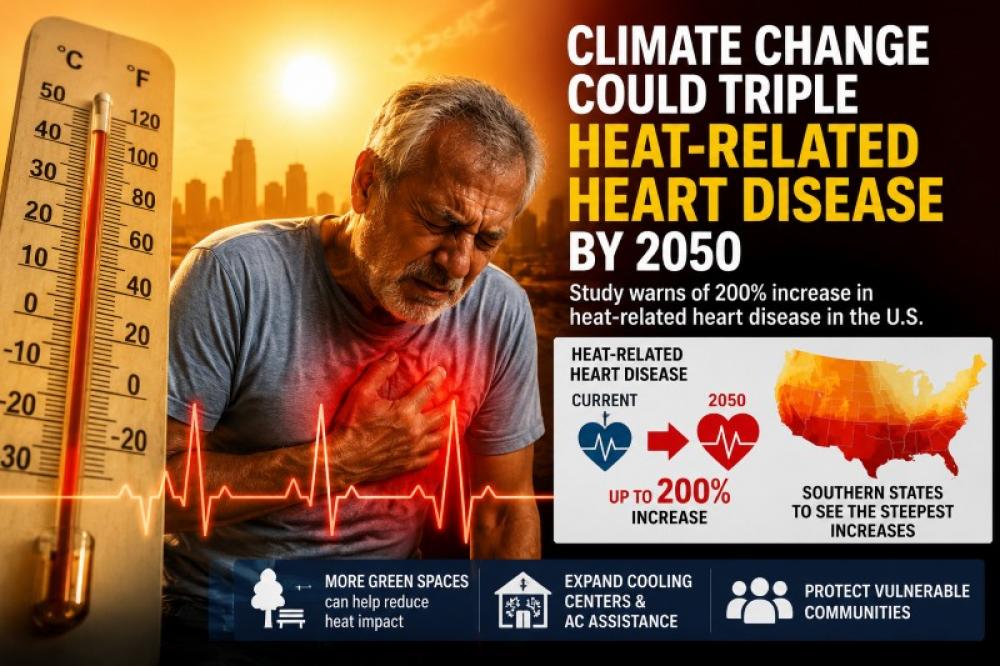
New study finds heatwaves may cause heart disease cases to skyrocket. Photo: ChatGPT
A new study by researchers from Case Western Reserve University, University Hospitals and the Louis Stokes Cleveland VA Medical Center has warned that rising temperatures driven by climate change could dramatically increase heat-related heart disease across the United States.
Published in JAMA Cardiology, the study estimates that heat-related cardiovascular disease could surge by as much as 200% by 2050 if current warming trends continue.
Researchers analyzed county-level heart disease data across the contiguous United States from 2010 to 2016 and developed projections through 2050. The team combined cardiovascular burden estimates from the Global Burden of Disease database, NASA-derived climate projections and U.S. Census Bureau population data to model future health impacts.
"We already knew that extreme heat could trigger heart attacks and other cardiovascular events," said Gokul Parameswaran, lead author of the study and a research associate at Case Western Reserve University's Cardiovascular Research Institute. "But this study is the first to map out exactly how severe the problem could become—county by county across the United States."
The researchers also found that lower-income states are likely to face a disproportionately higher burden of heat-related heart disease.
According to the U.S. Centers for Disease Control and Prevention (CDC), high temperatures force the heart to work harder to cool the body while also increasing the risk of blood clots. This added stress can trigger heart attacks and worsen existing cardiovascular conditions, particularly among older adults and people with underlying heart disease.
The study identified the Pacific Northwest as currently having the highest rates of heat-related cardiovascular disease. However, Southern states are projected to experience the sharpest increases by 2050.
"We believe this increase in the South may be driven by three converging factors," said Salil Deo, associate professor in the Department of Surgery and one of the study's senior authors. "The region already has one of the nation's highest heart disease burdens, faces some of the fastest projected temperature increases and includes many counties with limited healthcare infrastructure and high poverty rates."
Researchers also found that population aging alone could contribute to an additional 34% increase in heat-related heart disease by 2050, regardless of rising temperatures.
The study highlights several strategies that could help mitigate the health risks, including expanding urban green spaces and tree cover, increasing access to cooling centers and strengthening air-conditioning assistance programs for low-income communities.
"Climate change is not a distant, abstract threat," said Sanjay Rajagopalan, director of the Cardiovascular Research Institute and chief of Cardiovascular Medicine at University Hospitals Harrington Heart & Vascular Institute.
"It is a present and growing danger to the cardiovascular health of Americans, particularly the most vulnerable. Decisions made today on emissions, urban planning and healthcare policy will determine how many lives can be saved in the decades ahead."